
Rocket League Fundamentals: The Secret to Improving Faster
Most players want the secret to Rocket League improvement. They want the perfect training pack, the perfect mechanic, the perfect settings, or the perfect camera angle that somehow turns them into Zen overnight. Mechanics are important, of course, but for most players, they are not the real reason they are stuck.
The real problem is usually much deeper. Most players do not understand their own gameplay well enough. They think they are rotating, supporting, pressuring and defending properly, but when you actually watch the replay, the story is very different.
That is why Rocket League fundamentals matter so much. Not because they are “basic”, but because they are the foundation that makes everything else work. If your fundamentals are weak, your mechanics become random. You might score the occasional nice goal, but your overall game will still feel inconsistent, messy and frustrating.
Rocket League fundamentals are not just beginner stuff
When people hear “fundamentals”, they often think it means beginner advice. Hit the ball, rotate back, don’t own goal, try not to play like your controller is upside down. Lovely stuff, but that is not what proper fundamentals really mean.
Real Rocket League fundamentals are the decisions underneath your gameplay. They include positioning, spacing, pressure, support play, shadow defence, goal-side discipline, boost security, first-man decisions, second-man positioning and knowing when not to touch the ball.
That last one is where a lot of players struggle. They think being involved means they are helping, but that is not always true. Chasing is involvement. Panicking is involvement. Sitting directly up your teammate’s exhaust pipe is involvement. None of that means you are playing good Rocket League.
Good fundamentals make the game easier for your team. Bad fundamentals make the game feel like a hostage situation.
Normal Rocket League stats do not explain why you are stuck
Most players judge their performance from the scoreboard. Goals, shots, saves, assists, points and boost usage can all be useful, but they only tell part of the story. They show what happened, but they rarely explain why it happened.
You can have three saves and still be defending badly. You can have five shots and still be attacking badly. You can be top of the scoreboard and still be the reason your teammate had no space all game.
This is why normal Rocket League stats can be misleading. They reward activity, but they do not always reward quality. The scoreboard does not tell you if your pressure was useful, if your support position helped your teammate, if you were goal-side when it mattered, or if your rotation actually protected the dangerous space.
That is where real Rocket League improvement begins. You need to understand your gameplay deeper than the scoreboard.
The secret to Rocket League improvement is better diagnosis
Most players do not need another random tip. They need a better diagnosis. “Rotate better” is not enough. “Play faster” is not enough. “Work on mechanics” is not enough. Those things might be true, but they are too vague to be useful on their own.
A Diamond player might think they need better air dribbles, when the real issue is that they constantly leave their teammate in 1v2s. A Champ player might think they need to play faster, when the real issue is that they challenge everything like they are trying to win a pub fight. A Grand Champ player might think they need more mechanics, when the real problem is spacing, pressure timing or second-man discipline.
That is why testing your Rocket League fundamentals matters. It stops you guessing. It shows you which part of your gameplay is actually costing you games.
This is why I built Pacifist Score
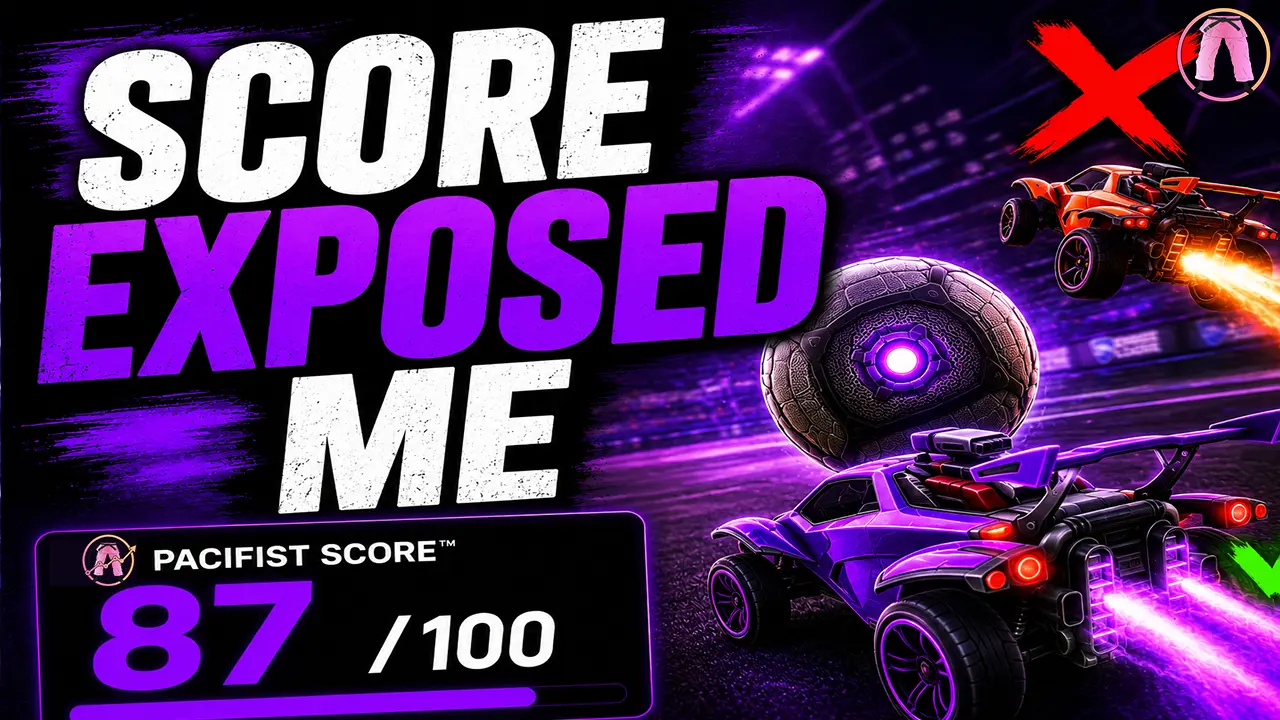
Pacifist Score is being built to test your Rocket League fundamentals in 2v2. It is not just another tool for counting goals, saves, shots and boost. The goal is to look at the decision-making layer underneath the game.
Pacifist Score looks at areas such as offensive offence, offensive defence, defensive offence, defensive defence, goal-side discipline, support spacing, central lane control, deep net opposite-side coverage, boost security, pressure and team shape.
In simple terms, it is trying to answer one question:
Are your decisions helping your team win, or are you just being busy?
That is the difference. A player can look active and still be useless. A player can touch the ball constantly and still make every play worse. A player can be fast and still be fast into terrible positions. Pacifist Score is designed to make that visible.
Pacifist Score helps you understand your gameplay deeper
The point of Pacifist Score is not to turn Rocket League into a spreadsheet. The point is to show you the patterns that are hard to see while you are playing. Most players can feel when a game is going badly, but they cannot always explain why.
Maybe your spacing is too close. Maybe your pressure is fake pressure. Maybe you are rotating out at the wrong time. Maybe you are never goal-side. Maybe you are giving away the centre too easily. Maybe you are making your teammate’s life harder without realising it.
Once you know the real leak, improvement becomes much clearer. You stop thinking, “I need to get better at Rocket League”, and you start thinking, “I need to fix this specific decision-making habit.”
That is a much better way to improve.
The new Road to GC with Pacifist Score series
I have started a new Road to GC with Pacifist Score series, but it is not a normal “watch me rank up” series. That has been done a million times. The point of this series is to show how Pacifist Score reads real games.
The series is about the decisions, the spacing, the pressure, the defence and the small habits that decide whether you climb or stay stuck. It is designed to show the fundamentals that normal Rocket League stats miss.
You can watch the first episode here:
This is the public test. Can Pacifist Score show why games are being won or lost? Can it expose the decision-making leaks that keep players stuck? Can it point players towards a clearer path to improvement?
That is what I want to prove.
Book owners can test Pacifist Score before release
Before Pacifist Score goes live properly, I am running more real 2v2 replays through the system. Not perfect examples. Not cherry-picked games. Real players, real ranks and real questionable Rocket League decisions.
If you own the digital or physical book, you can claim a free pre-release Pacifist Score report by leaving an honest review of The Ultimate 2v2 Guide on pacifist.ac.
Good review, bad review, short review, detailed review, whatever. Just make it honest.
Then message me in Discord with your replay. You can send a replay you struggled in, a replay where you think you played well, or a replay where you have no idea why you lost.
This helps me test Pacifist Score before release, and it gives you an early look at your biggest decision-making leak.
Final thought
The scoreboard is loud, so everyone looks at it. But the best Rocket League decisions are often quiet. Good positioning does not always give you points. Good support does not always show up as a stat. Good defence does not always require a save. Good pressure does not always mean touching the ball.
That is the secret to Rocket League improvement. Stop only asking what happened. Start asking why it happened.
Test your fundamentals. Understand your gameplay deeper. Fix the real leak.
Pacifist Score is coming soon for digital book owners.
Learn The Pacifist System and get ready here: